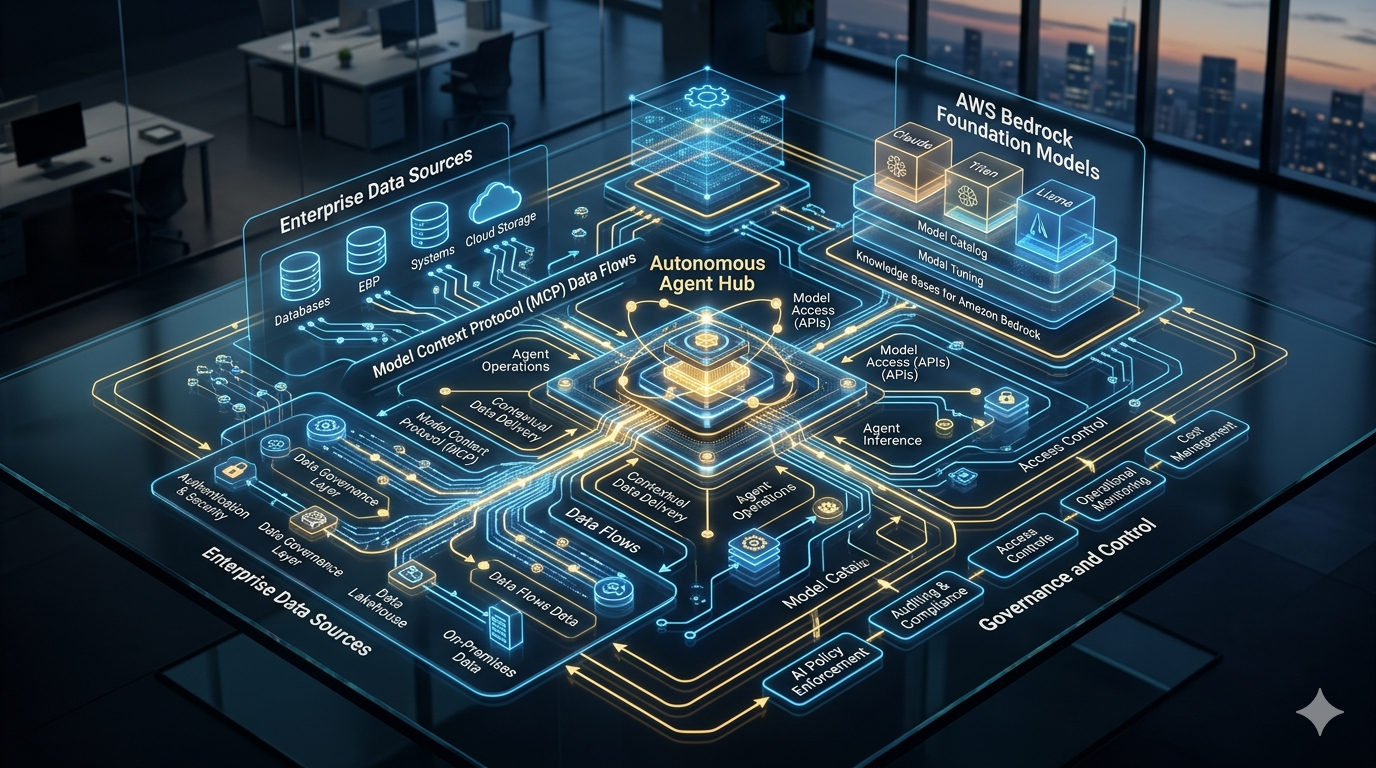
It is hard to believe we are already halfway through 2026, and most organisations have now made their AI strategy decisions for the year. I took a look at how the biggest tech players are shaping enterprise AI right now, and pulled the findings into a simple summary — easier to read than a stack of product pages, keynote clips, and press releases.
I also want to be transparent: I used AI to help me write this article. But the research, structure, and thinking behind it came from my own reading, note-taking, and architectural lens. For me, that balance matters: AI can help us move faster, but it should not replace the curiosity and judgment behind the work.
What stands out most in 2026 is that enterprise AI is no longer being sold as a clever assistant. It is being positioned as a governed operating layer for real business work.
The Shared Direction
Across the major platforms, there is now a clear consensus.
- Hybrid architecture is the default: Enterprises are not replacing core systems overnight; they are integrating AI into existing data, application, and workflow landscapes.
- Governance is part of the product story, not an afterthought: Microsoft, Google, AWS, and IBM all emphasise trust, control, permissions, observability, and enterprise-grade security as core features of AI deployment.
- From "chat" to "agentic execution": The emphasis is increasingly on AI that can complete tasks, invoke APIs, coordinate across systems, and operate inside defined enterprise boundaries.
That is a meaningful shift for architects. It means the conversation is no longer only about models. It is about control points, orchestration, accountability, and lifecycle management.
Where Vendors Differ
The more interesting part is where the big players are taking different architectural bets.
Microsoft
Microsoft is anchoring its AI strategy in the work surface itself. The Frontier Suite brings productivity, security, identity, Copilot, and agent governance into a single enterprise motion — which tells you where Microsoft believes the control plane should live: close to the employee and close to the enterprise trust layer.
Google is pushing a cleaner agent-platform story. Its Gemini Enterprise Agent Platform creates a single environment to build, scale, govern, and optimise autonomous agents, which makes its direction feel more platform-native and more explicitly agent-first. In other words, Google is saying the enterprise needs an operating environment for agents, not just a model endpoint.
IBM
IBM is taking a slightly different route. Enterprise Advantage is less about flashy product positioning and more about helping clients build, govern, and operate tailored internal AI platforms at scale. That is a consulting-led, asset-based approach that fits large enterprises looking for repeatable value across hybrid estates.
AWS
AWS is leaning into execution and runtime orchestration. Bedrock Agents and AgentCore focus on building generative AI applications that can execute business tasks by invoking company-specific systems and APIs. That makes AWS feel strongest in the "agent as infrastructure" category rather than "agent as workplace layer".
SAP and Salesforce
SAP and Salesforce are more domain-embedded. SAP's Joule direction reflects AI built into ERP and business process flow, while Salesforce's agentic story centres on CRM and customer-facing work units. That is a useful reminder that not every enterprise AI architecture should look generic; sometimes the most effective pattern is the one closest to the business core.
What Service Providers Must Do
This is where the real delivery opportunity sits.
For firms navigating large-scale transformation programmes, the winning move in 2026 is not to say "we do AI." Everyone says that. The stronger play is to become an AI orchestration partner that can help clients connect models, data, governance, workflow design, and change management into one delivery system.
That means building reusable industry assets, multi-vendor integration capability, and AI governance accelerators. It also means moving delivery teams up the value chain: less staff augmentation, more platform thinking, more agent lifecycle support, and more outcome-based delivery.
The providers that stand out will be the ones that can answer practical questions such as:
- How do we govern agents safely?
- How do we integrate AI into existing platforms without creating chaos?
- How do we measure value without overpromising?
- How do we scale across cloud, data, and regulation boundaries?
What This Means for Work
The biggest mistake in AI conversations is still to frame everything as job loss. What is actually observable is a role shift. AI is changing the composition of work, the shape of teams, and the skills that matter most.
Enterprise architects, business analysts, operations leaders, platform engineers, and process owners are likely to feel the change first — because they sit where business intent meets system design. Their work will increasingly involve supervision, orchestration, validation, and exception handling rather than only manual execution.
By 2027 and beyond, AI literacy will no longer be a nice-to-have. It will be part of the baseline for knowledge work, especially in roles that influence architecture, governance, and operating model decisions.
Where TOGAF Needs to Evolve
This is where the architecture lens matters. TOGAF is still relevant, but AI demands a more adaptive version of it. A static, linear ADM is not well-suited to an environment where models, prompts, agents, policies, and data flows change continuously.
One possible way to think about extending the framework for the AI era:
- Dynamic ADM loops rather than one-way phase progression.
- Agents, prompts, policies, and evals treated as first-class architecture objects.
- Governance and observability built into design, not bolted on later.
- A clear lifecycle for AI assets, including versioning, testing, monitoring, and retirement.
In practice, that means architecture becomes more operational and more continuous. It is no longer just about defining the target state. It is about managing a living system that learns, changes, and needs guardrails.
A Regulated-Environment Lens
There is also a UK and EU angle worth considering. Organisations operating in highly regulated environments — such as financial services — are naturally more cautious about governance, traceability, and data sovereignty. That makes the architecture choices around control, policy, and data handling even more consequential.
For those organisations, the AI question is not only "what can this do?" It is also "can we govern it, explain it, and defend it?" That pressure will continue to shape enterprise architecture decisions well beyond 2026 — and it is worth building that constraint into architectural thinking from the outset, rather than treating it as a late-stage compliance consideration.
Closing Thought
The most interesting thing about enterprise AI in 2026 is not that the technology is getting smarter. It is that the architecture around it is becoming more important.
The winners will not necessarily be the organisations with the loudest AI strategy. They will be the ones that can turn AI into a governed, usable, and scalable part of how work actually gets done.
#EnterpriseAI #EnterpriseArchitecture #TOGAF #AIGovernance #AgenticAI #FutureOfWork #DigitalTransformation #ArchitectureLeadership
The views expressed in this article are those of the author and reflect independent practitioner analysis based on publicly available research and general professional experience. They do not represent the views of any employer, client, or organisation. All frameworks and patterns referenced are illustrative in nature.